
In this issue of
- Against All Odds – Whitewater Valley
- Leadership Matters – Whitewater Canal Association
- Recollections of John Frederic William Meyer
- Rodmen Made Way For Canals
- Delphi, Indiana News & Events
- Canal Society of Indiana News & Events
Against All Odds – Whitewater Valley
Robert F. Schmidt
Canals can only successfully be built when geology, economics and the local political structure are all in proper alignment. Today we find ourselves trying to figure out the next preservation steps for the Whitewater Canal State Historic Site. Let’s explore the origins of the site. Against all odds, how did it come to fruition in the first place? Geology, politics and economics all played key roles.
The geology alignment begins with the Wisconsin Glacier about 12-15,000 years ago. About 11,700 years ago, after a period of global warming, glaciers began to retreat, water poured into the Whitewater Valley and created two narrow steep gorges on the east and west side of a highland in the middle. Two branches of Indiana’s fastest flowing river merged mid-valley at present day Brookville, Indiana, and continued south merging with the Great Miami River and then the Ohio River. The two narrow valleys, both with steep gradients (fall), always produced flooding along both branches of the Whitewater River. The favorable impact was that there was plenty of water for a canal, but there also was the negative factor of flooding and the destruction of canal structures along the route.
Another favorable geological factor was that there was plenty of quality limestone available from the Derbyshire Quarry west of Laurel, Indiana, to construct locks and culverts. Other geologic conditions were not so favorable. The Whitewater Valley is narrow, meaning the canal had to be constructed close to the river. Hills were steep. Without water sources near the top of those hills, canal building made them impossible to cross. There were only three choices for canals: deep cut, tunnel or avoid the hills.
The American Revolution officially ended in 1783 with the signing of the Treaty of Paris. The area west of the Alleghenies to the Mississippi was now American soil. Congress adopted the Land Ordinance of 1785 that established a system of land survey for the new territory. Each Congressional Township would have 36 one-mile sections of 640 acres. This was the beginning of the rectangular land system used in most of the country today. In 1787 the area north of the Ohio River was designated the Northwest Territory. Marietta, Ohio, became its capital with General Arthur St Clair its Governor.
In 1788 John Cleves Symmes received a land grant from Congress for 311,000 acres that included the future city of Cincinnati, Ohio, for land between The Great Miami and Little Miami rivers. Settlers quickly followed and Ft. Washington was established in 1789 to protect the area residents from Indian raids. The Whitewater River enters The Great Miami a few miles south of Harrison, Ohio. Settlers soon moved into the Whitewater Valley, a natural pathway to the northwest, that was still Indian Territory and outside of Symmes’ grant. After defeating the Indian Confederation at Fallen Timbers in 1794, General Anthony Wayne called for treaty negotiations in 1795 at Greenville, Ohio. To protect these earlier Whitewater settlers, he provided in that treaty agreement that the territory of the U.S. government would be extended eastward by a line from Ft. Recovery, Ohio, to the mouth of the Kentucky River. This placed the Brookville area and portions of the Whitewater Valley into U.S. Government Territory.
Following the concept of rectangular land settlement. Congress designated a north-south line called the “Principal Meridian” at the edge of Symmes’ land grant at the mouth of the Great Miami River. Just north of the Ohio River this meridian line crosses some large hills that place portions of those hills east of the line in the state of Ohio and west of that line in Indiana Territory. No thought at the time was given to any transportation impact between states. At the same time Congress established Indiana Territory (May 1800), but they still left the “Gore” remaining in the Northwest Territory.
When Ohio applied for statehood in 1802, the Ohio Enabling Act provided that the state’s western boundary would be the Principal Meridian. The triangular shaped area, known as the “Gore”, was transferred to Indiana Territory even though the residents of the area were economically tied to the Cincinnati market. From then the whole valley was politically locked with Indiana. To compensate the residents of the “Gore,” a new county, named after Secretary of War Henry Dearborn, was created in 1803 with its county seat on the Ohio River at Lawrenceburg. The Indiana Territorial capital remained to the west some 160 miles away in Vincennes, Indiana, on the Wabash River. This transfer of territory brought over 7,000 new residents into Indiana Territory and they now accounted for about 30% of the territory’s total population. This meant that Dearborn County would now carry more political power in the territory than most other areas in the new State of Indiana. If the “Gore” had remained in Ohio, the valley settlers probably would not have had much political power.
Would a canal have been built to Cincinnati? My first inclination is that the Whitewater Canal would never have been built if this “Gore” territory would have remained in Ohio. Without much political power, the valley was too steep to safely build a canal. Later, Ohio had other canal plans that would really have placed the Whitewater on the back burner. Unfortunately, the Principal Meridian line left some of the hillside still in Ohio. This meant that any further Whitewater Canal construction would have to enter Ohio, because at the summit of these hills there wasn’t a sufficient water supply.
For Indiana there were two choices: build a rail connection to Lawrenceburg or get agreement with Ohio to build 7 miles of canal in its state. This was not a bad situation for valley residents. If the hills were not there, Indiana would have built directly to Lawrenceburg, which really was a secondary outlet to reach steamboats on the Ohio River. With the need for concessions to Ohio there was at least the possibility that Ohio would be able to connect with the Whitewater Canal and canal boats could reach their primary market, Cincinnati.
The final result was that the Whitewater Canal was finally built with state and private enterprise. With the completion of the Hagerstown Canal being added to the Whitewater Canal, they extended 76 miles to Lawrenceburg, Indiana. The Cincinnati & Whitewater Canal was built for 25 miles through the hills by building a tunnel at Cleves, Ohio, that tapped into the Whitewater Canal at West Harrison, Indiana. The West Harrison to Lawrenceburg portion of the Whitewater Canal ended in 1849 due to flooding. The route to Cincinnati ended in the early 1850s. The traffic and revenue from both canals were not sufficient to offset the maintenance costs from the continuing flood damage. The abandoned towpath provided the railroad with a tunnel in Ohio and easy access to Connersville. The Whitewater Canal was sold to the railroad in 1862. There was some hydraulic use of the canal until the 1930s. This was the final Whitewater Canal situation until the 1940s when preservation actions began.
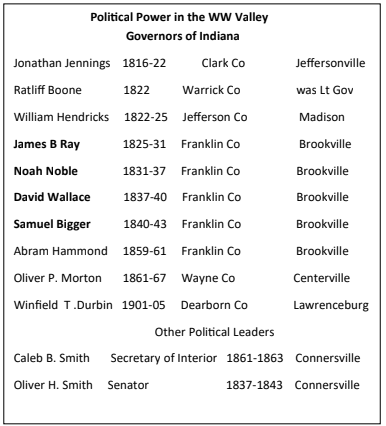
The population of the Whitewater Valley brought political power. Four Governors in succession came from Brookville, all Whigs and all pro internal improvements. Governor Ray favored the new technology of rails vs the old reliable canals. Later, other Governors and political figures came from the Whitewater Valley.
The first meeting to consider a canal came in 1823 when newspaper editor from Brookville, Augustus Joselyn, called a meeting at Harrison to discuss the possibilities of a canal or rail system to reach Lawrenceburg. It was then obvious that to reach Lawrenceburg any canal would have to be built into Ohio. The Indiana canal projects received new stimulus when the Erie Canal was completed in 1825. Ohio broke ground for 2 canals in July 1825. In 1826 the U.S. Congress authorized a survey of the Whitewater Valley. Colonel Shriver arrived at Brookville in June 1826 and began to survey the route. He was called up north for more work on the Wabash & Erie Canal, so his work in the Whitewater Valley was completed by Colonel Stansbury. Stansbury concluded that a canal here would be impractical.
The project was revived in June 1834 when William Gooding, assisted by Jesse L. Williams, completed another survey by the direction of Indiana’s Governor Noah Nobel. Guess what? They concluded that despite the 491-foot drop from Hagerstown to Lawrenceburg, a Whitewater canal was possible. Governor Noble sent Jerimiah Sullivan to negotiate terms for the Wabash & Erie Canal up north. Ohio finally negotiated agreement for a northern portion of W & E canal in Ohio. Ohio at first also said “No” to a Whitewater Canal entering its state, but it finally agreed to allow access only if Indiana would permit Ohio to eventually tap in at Harrison for a Cincinnati & Whitewater Canal. Indiana agreed, knowing that such a canal in Ohio would take some time. The “Buckeyes” were busy up north working on the Wabash & Erie Canal from Toledo and down south extending the Miami Canal northward to Junction, Ohio. Nevertheless, a private venture was started in 1836-37 out of Cincinnati, but that canal didn’t reach Harrison until 1843.
Indiana also began the White Water Canal in 1836 from Brookville to Lawrenceburg and that portion was completed by 1839. Unfortunately, by 1839, Indiana ran into financial difficulty and all Whitewater Canal work was terminated. During this period work on the Cincinnati & Whitewater also slowed due to the financial situation and the difficulties of building the Cleves tunnel through a hill on the William Henry Harrison property.
In 1842 Henry S. Valette, a wealthy businessman from Cincinnati, agreed with the state of Indiana to buy Indiana’s Whitewater Canal and headquarter it at Connersville. He would only agree to extend the works to the National Road at Cambridge City, not to Hagerstown as Indiana had originally planned.
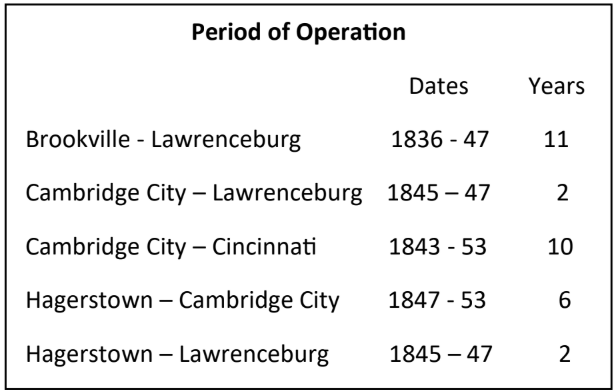
The Hagerstown merchants formed their own Hagerstown Canal Company and hired a Pennsylvania engineer, John Minesinger. Minesinger had done survey work on the Whitewater Canal with Goodings & Williams back in 1834. The Hagerstown canal extended 8 miles south and connected with the Whitewater Canal at Cambridge City by 1847. The functioning timeline of the various canal segments of the Whitewater system looked like this:
Over the years economic development and population have shifted within Indiana. The political influence has also shifted. The Whitewater Valley is left with a historic canal and scenic beauty, but it has a lack of state resources to restore the Whitewater Canal. Once again private support is needed.
House District 55 Lindsay Patterson Out of 100 = 1% Add Wayne 1.4%
Leadership Matters – Whitewater Canal Association
Robert F. Schmidt
A genuine interest in history and preservation efforts are generally not found among the general population, but rather just in small groups of people who recognize the value of studying the past to understand our current circumstances and perhaps learn more about ourselves. Neither of these pursuits are the path to economic gain, but these fields do seem to attract persons who have achieved financial success and are willing to share their wealth in preservation efforts. The United States is blessed with hundreds of these individuals who have reached out to preserve our heritage.
The Whitewater Canal Association is a prime example and is found right here in Indiana. By the early 1940s the Whitewater Canal had faded into history. Due to the frequent flooding of the Whitewater River, Indiana decided that a reservoir was needed on one of the branches of the river. A group of Hoosiers were determined that this project not impact the remains of the old canal. They gathered a group of influential people throughout the state to save the remains of the Whitewater Canal. In 1941 these people formed the Whitewater Canal Association in Brookville, Indiana. Who were these key supporters and what was their background?
Pres. John P. Goodwin
Brookville
1880-1972
Age 92
FG #115347538
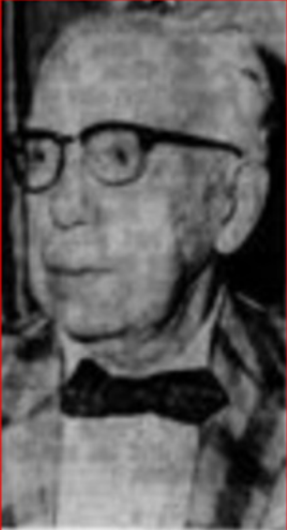
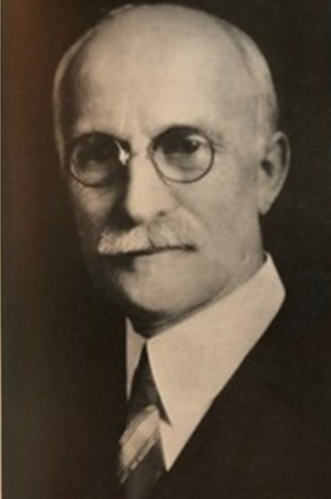
Goodwin was the key organizer of the association. He was a banker, businessman and Director of Brookville Telephone Co. & Franklin Furniture Co.
V. Pres. George A. Ball
Muncie
1862-1955
Age 92
FG # 63506821
Ball was one of five Ball brothers who operated Ball Brothers Co. in Muncie that made glass canning jars. In 1917 the Ball brothers acquired Indiana Normal School, which has today become Ball State University.
Sec. Alfred C. Brown
Brookville/New Trenton
1897-1972
Age75
FG # 120093181
Owner of A.B. Beverage Co., Franklin Co Auditor, and Veteran WW I & I I – rank Major
Trea. Cornelius O’Brien
Lawrenceburg
1883-1953
Age 70
FG # 64878860
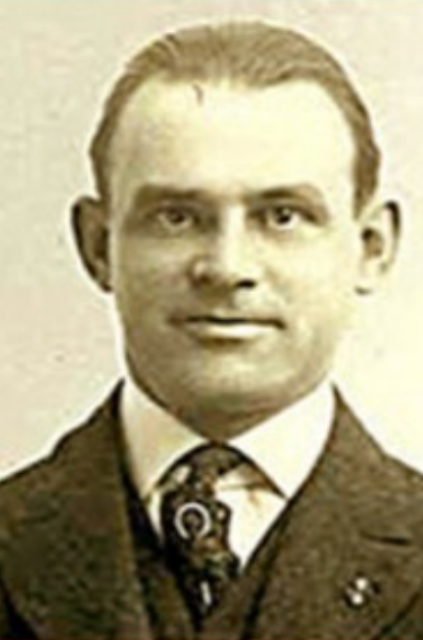
Cornelius O’Brien was a successful banker, farmer, and manufacturer and was among the first to recognize the need for preserving Indiana’s historic buildings and sites. He was on the board of the Indiana Historical
Society. His daughter, Mary, established an annual lecture series in his honor.
1st Exc. Sec Harold F. Brigham
Indianapolis
1897-1971
Age 73
FG # 41926282
A New Jersey native, he came to Indiana in 1942 to become the Director of the Indiana State Library. Later he served as the Executive Secretary of the Indiana Commission of Public Records. Throughout his career as a librarian he held several positions with the American Library Association.
2nd Exc. Sec. Howard H. Peckham
Indianapolis
1910-1995
Age 84
FG # 68741040
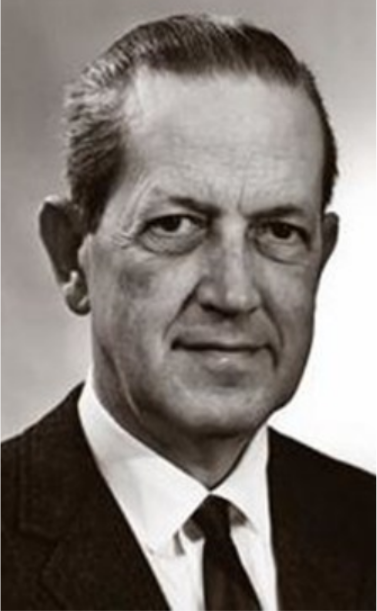
A noted history scholar, who came to Indiana from Michigan in 1945 to head up the Indiana State Library and History Bureau where he remained for 8 years. He also was the Secretary of the Indiana Historical Society where he worked to establish professional standards and collected papers on the Northwest Territory. He wrote 2 books while here on Indiana history.
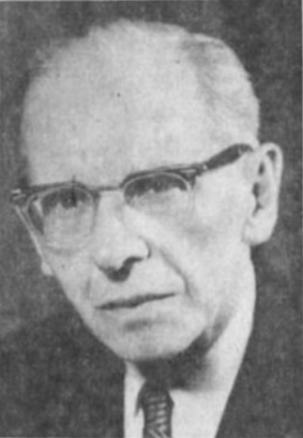
Luther M. Feeger
Richmond
1883-1975
Age 92
FG # 40780449
A recognized Historian, he was Managing Editor of the Richmond Palladium and worked at that newspaper for 60 years (1913-1973). In 1953, he began a series of articles about the “History of Transportation in the Whitewater Valley” and especially Wayne County. He wrote over 7,000 historical articles. In the early 1940s he authored a book entitled “A Brief History of Early Richmond.” He was a board member of the Indiana Historical Society.
Maurice “Boss” Johnson
Aurora
1879-1959
Age 79
FG # 19929139
Johnson was a pioneer of radio farm programs. He worked with WLS, Chicago, WLW, Cincinnati and produced the “Truly American” programs from 1925 to 1952. He was also the featured speaker of the radio show “Everybody’s Farm Hour.”
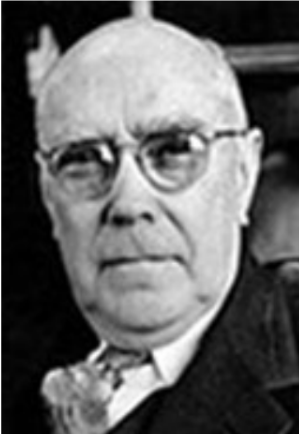
Eli Lilly
Indianapolis
1885 -1977
Age 91
FG # 7357427
Businessman, Historian, Preservationist, Author, Archaeologist, and Philanthropist, Eli Lilly Co. has become a leader in insulin products. Lilly Endowment in 2025 has again come to the rescue of the Whitewater Canal project. Eli was President of the Indiana Historical Society for many years.
Walter H. Lowe
Greensburg
1896-1976
Age 79
FG # 50547139
Newspaper man, Civic leader, Businessman
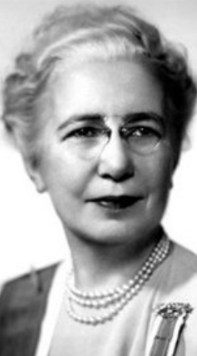
Mrs. Roscoe C. O’Byrne “Estella”
Brookville
1891-1987
Age 95
FG # 172301264
Wife of Roscoe C. O’Bryne, who was the judge of the 37th Circuit: Franklin-Union counties He was running for judge on the Indiana Supreme Court in 1942. Estella was President of the Indiana Chapter of the DAR. Prominent Brookville residents Roscoe died in 1950
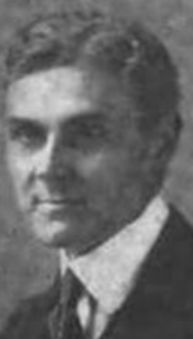
John Jay Rowe
Cincinnati
1885-1965
Age 79
FG # 110849263
Prominent banker in Hamilton County, Ohio.
Mrs. Donald H. Teetor “Elizabeth”
Hagerstown
1905-1995
Age 90
FG # 241049587
Wife of Donald Teetor. Don was the Vice President of Perfect Circle, a manufacturer of piston rings headquartered in Hagerstown. The company was sold to Dana Corp in 1963.
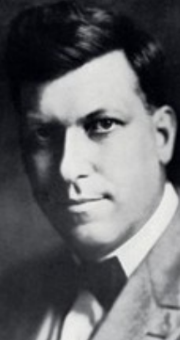
Harry O. Garman
Indianapolis
1880-1952
Age 72
FG # 45904793
Consulting Engineer – Indiana Dep. of Conservation (DNR). In 1944 he wrote the booklet “Whitewater Canal” – history statistics & maps. He was a member of IHS, Indiana Pioneers, and an original board member of the Whitewater Canal Association.
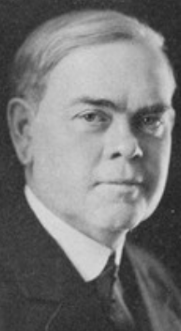
Jesse C. Moore
Indianapolis
1868-1957
Age 88
FG # 218540831
An Indianapolis attorney, he was born in Delphi, IN. He was also a trustee of Franklin College. He replaced Harry O. Garman who died in 1952.
Ensley W. Johnson
Indianapolis
Died in approx. 1949?
President of the Society of Indiana Pioneers that was founded in 1916. He was an original board member of the Whitewater Canal Association.
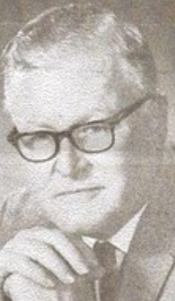
Milford Anness
Liberty / Columbus
1918 – 1992
Age 74
FG# 57038545
Lawyer, Author, and State Senator who owned a hardware store in Metamora for 10 years. He replaced Ensley Johnson who died in 1949 (?).
When selecting its officers and board members, the Whitewater Canal Association gave considerable thought to the various talents of the members and their potential contribution to the challenges they were facing to save the remains of the Whitewater Canal. All regions along the canal route from Hagerstown to Lawrenceburg were represented, even into Ohio at Cincinnati. There was a balance of businessmen with certain skills and other members who could offer financial support. Newspaper and radio men were selected. Several women were also added, which was uncommon at that time. There was even an indirect legal connection through Estella O’Byrne of Brookville and an Indianapolis lawyer. There were representatives from Indianapolis, the State Library and the Indiana Department of Conservation (DNR). It was a blue ribbon panel that would become a powerful force for preservation.
Under the leadership of John Goodwin of Brookville, the group raised funds and began purchasing land from the Laurel feeder dam to Brookville. This work continued for 5 years while, at the same time, they were seeking state support of the project. In 1946 these efforts were rewarded when they transferred title to 14 acres of acquired lands to the state of Indiana, which then created the Whitewater Canal Historic Site.
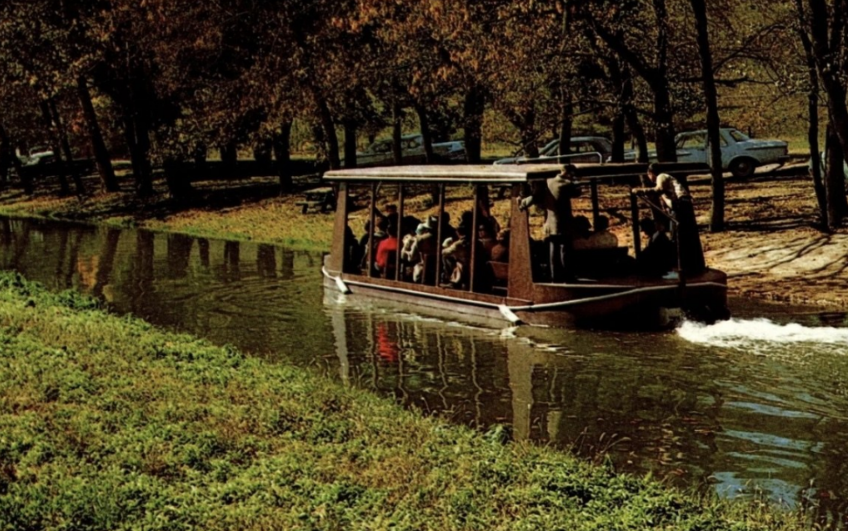
operated on the Whitewater Canal from 1964 to 1979.
Courtesy of Cassie Garrett
The Indiana Department of Conservation became the Indiana Department of Natural Resources in 1965 and continued to operate the Whitewater Canal Historic Site. Originally the 1845 Metamora Grist Mill on the site was the only fund generating activity. A small boat ride on “The Valley Belle” was added as an attraction to the site in 1964 and operated there until 1979. That ride took its passengers through Lock # 24 eastward and then returned again through the same “Millville” lock. The 30 ft. long x 10 ft. wide fiberglass boat was built by the Schenkel brothers in Cedar Grove, Indiana. It had a 120 horsepower jet pumped Ford engine.
In 2011 the Whitewater Canal Historic Site was transferred from DNR to the Indiana State Museum, who operated several other historical locations in the state. The nearby Brookville Reservoir was originally part of the Whitewater Canal site and its recreational revenue contributed to the support of the canal site. When the two locations were separated the canal portion lost its revenue base.
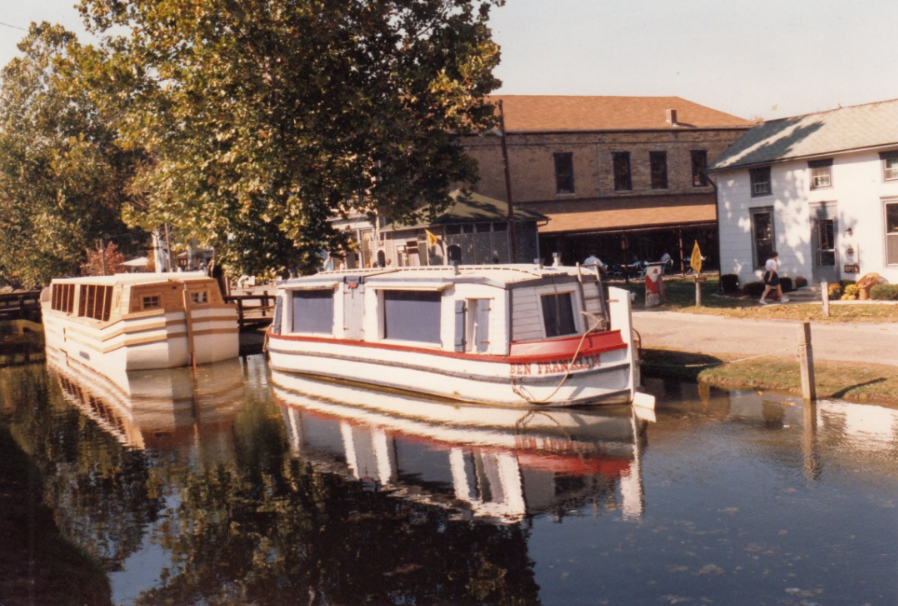
Metamora on the Whitewater Canal shortly before the Ben
Franklin II was retired.
Photo by Louise Larsen, April 1990
The first reconstructed canal boat on the canal was the Ben Franklin II, which was dedicated in 1981 and then replaced with the Ben Franklin III in April 1990. These boat rides were popular attractions for the various visitors and provided some revenue. The Ben Franklin III met its end in April 2022 when it split in half during some scheduled repairs. Over the years the Duck Creek Aqueduct and the Laurel Feeder Dam also deteriorated.
Currently the State Museum is evaluating the next plan for restoration of the site. $14.4 million dollars has been accumulated through state funding and a grant from the Eli Lilly Foundation. In early November 2025 the local residents of Franklin County are appealing to the State Board of Accounts to release $4 million of the state funds to begin restoration of the Duck Creek Aqueduct.
Recollections of John Frederic William Meyer
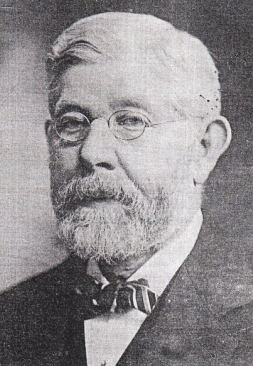
J. F. W. Meyer
1824-1910
Old Fort News, VOL. XXIV
No. 4 Oct.-Dec., 1961
John Frederic William Meyer, age 23, who was known as William, and his brother, Christian Frederick Gottlieb Meyer, age 17, who was known as Fred, decided to come to the United States in Friends and relatives, the Gerkes, from the surrounding area where they lived in Prussia, had come earlier and settled in Adams county, Indiana, a 7 hour trip to Ft. Wayne. They had corresponded over the years with the Gerkes and were welcomed to stay with them. This gave them a destination.
Used with permission of the
Fort Wayne History Center
In his recollections, William at age 75, wrote in German about his early life in Prussia, all the trials and tribulations he and Fred experienced when coming to America, how each of them cheated death on several occasions, their travel by canal boat on the Miami & Erie Canal to Bremen, Ohio, William’s work on a Wabash & Erie Canal boat at age 24 and how both he and Fred finally achieved success over the years.
William died on September 7, 1910 at age 85. Fred died on July 12, 1905 at age 74.
On the anniversary of the Reformation, I will begin to write a short story of my life, in which I want to speak especially of the wonderful way God has led me, and give Him praise and glory.
In 1417 John Henry Meyer married a girl of inferior rank, and without domain. Much as this act displeased his parents, they soon became reconciled and built a small house on the edge of their very large farm near Dielingen, Westphalia, Germany. This remained the home of their direct descendants until the year 1838.
My father was also named John Henry Meyer: my mother was born Margarethe Louise Hoolt, both from the congregation in Dielingen, Westphalia. They were married April 23, 1821. My father died when I was barely nine years old. After his death, I had to herd sheep, and in consequence had to miss school that summer. After that summer I was able to attend school, such as it was, very simple and wretched, regularly until I was almost fourteen years old.
That year our mother moved with us to Stemshorn, where I was confirmed in the Lutheran Church, and spent my time at home until I was fifteen. That year I was engaged as shepherd at Meyer and Klausemeyer’s Ilwede, and my wages were $15.00 (Prussian money) a year, and the privilege of feeding and pasturing ten sheep with theirs. The lambs and wool I sold, so that my wages were increased somewhat. While herding the sheep, I knit stockings and mittens for which I was paid.
After three years, when I was eighteen years old, I had to go home to do the work on the farm, and herd the sheep there.
When I was twenty-one years old, my dear pious mother died. I want to say here that she kept us from going sinful ways, by her admonition and prayers and by God’s grace. In our lessons for Confirmation we were taught that if we were virtuous all would be well, but when we came home from the lessons, our mother told us that our virtue was like a soiled dress before God, and only through faith in Him and His great love for us, by His grace could we enter the Kingdom of Heaven.
When I was twenty-three years old, I wished to go to America. I spoke of it to my brother Friedrich, who was then seventeen years old. As he was willing, I decided to ask my step-father’s permission to go. (We were brought up to be obedient.) He said we might go, but he would not help us with money. So I counted the money I had saved, which I had put away in a trunk, and found I had $150.00. I borrowed $15.00 from an older brother, and we left our home on September 15, 1847. On September 17th we took passage on an English sailing ship—Captain Duncan. We encountered great storms in the North Sea, but had many lovely days too, especially when we were at the Islands of Cuba and San Domingo, where it was very warm. We landed at New Orleans on November 17, 1847.
After a short stay we took a Mississippi steamer to Cincinnati where we stayed two days, or until we could get a canalboat that would take us near Fort Wayne. We found one that took us to Bremen, Ohio, where we landed on December 1, 1847. As it had turned very cold, with snow and ice, there was no other way to get to Fort Wayne than to walk. So we walked. The way from Bremen to Monmouth, Adams County, Indiana, was through a dense woods, and the trees were blazed to mark the way. For sixty miles we saw only six houses. After having walked thirty miles, we arrived at a tavern, where we spent the night. Our money was spent. We borrowed four dollars from a man by the name of Henry Wehrmeyer so we could pay for our night’s lodging and meals. When we were ready to leave in the morning, we laid our money on the table. We could not understand English, so could not understand the keeper of the tavern. He took just a little of the money and gave most of it back. Since we could not get anything to eat for the next thirty miles, we made our ships hard tack do and drank our of the river. At times brother Fred was so worn out he wanted to lie down and die, but at last we arrived at Monmouth at dusk so tired that it is not to be described. We went into a tavern there to inquire our way to the Herman Gerke home. The keeper of the tavern was named Dorvin. We had four more miles to go, through a dense forest, to get to our destination, and needed something to strengthen us. So brother Friedrich, who had picked up a little English, asked “Have you any whisky?” Mr. Dorvin set a bottle of whisky and two glasses before us. We drank a good glassful, then laid our money on the table, from which Mr. Dorvin took a very little. Then he showed us the way. By that time we were so anxious to get there we almost went on a trot. After about one and a half hours we arrived at Fred Christianer’s, where we found the mother of Mr. Christianer at home and she spoke to us in Low German (Plattdeutsch) and said “Sund yungens von Stemshorn? Wi dachten ji kamet nich mehr da et al so lathe in winter is.” (Are you boys from Stemshorn? We thought you would not come anymore as it is so far into winter.) The dear old mother told us we must eat with them before we went on further. As the house they lived in was just a small log cabin, we thought they would not have so very much to eat there, and asked whether Gerke’s had the same kind of house. They told us they had a covered log house. Then they began to serve the meal, and such a meal. Spare ribs, pork sausage, wonderful bread and coffee, and how god it tasted! After supper Mr. Christianer made a torch of hickory bark and took us to our Agnes and brother-in-law, Herman Gerke, where we were well received. That was December 3, 1847.
The next morning I was able to help my two nephews begin to clear twenty;-five acres of land to get ready to plant wheat between the stumps and trees that could not be removed. Brother Fred was so worn out that he had to rest for several days, but after that we both felled trees every day, until he was able to find work in Fort Wayne, where he worked for room and board and could not go to school at the same time.
I stayed at Gerke’s and worked clearing land until March 28th, 1848. That day I began to drive horses for a canalboat, which I did until the fourth of July. As it was then harvest time, our boat was anchored for several weeks. I went to Gerke’s and worked with cradle scythe. One day while I was working hard with the cradle I was overcome by the heat and was unconscious for several hours. Iwas very ill, so that they thought I would die. When Rev. Husmann heard that I was so ill, he rode nine miles to visit me. He found me with a goodly portion of self-righteousness, so he gave me a severe lesson of the Law of the Bible and left me. The next morning at four o’clock he was back. I had had a miserable night and was almost desperate. When he saw how I felt, he preached the Gospel and made me so happy telling me I should only believe and I would be saved. He made it so sweet that I never have forgotten it.
When I was well again I went back to the canalboat, as that was almost the only way at that time to receive pay in money. Then I was transferred to packet boat, where I received $18.00 a month. After a very short time I took malaria and was nursed by Mrs. Drave. By that time it was late in fall and I went back to Gerke’s and helped clear the land.
In December I bought eighty acres of land (woodland) for $205.00. I had saved $105.00 during the summer, so I owed $100.00 on it. I stayed at Gerke’s until February 7, 1849, when I was employed by Hugh B. Reed, a druggist. Brother Fred, by that time, had made “helper” at Reed’s. So then I was official bottle washer, hostler, bootblack and chamber fellow, for which I received the large salary of $15.00 per month. Out of that I had to pay for board and laundry. At that, I saved enough to pay for having twenty-one acres of land cleared.
I fully attended to live on my farm and knew it would be impossible without a wife and helpmate. So I looked about for a good pious wife. My attention was called to a girl whose parents lived at Grosenherse C. Preusminden, Germany. I wrote to them and asked their consent to court their daughter. Their answer was that they would inquire about me in Stemshorn, (which they did) but since the distance was great between them and their daughter they would leave it to her to decide. I then sought her society, and we soon found that we cared for each other. Her name was Carolina Schroeder. I then showed her the letter from her father, and we were engaged in the fall of 1850. She remained at her place of employment until the 22nd of May, 1851, and the next day we were married, May 23 in the old St. Paul’s Church, by Rev. Sihler. Our guests were brother Fred, Rev. Sihler, the Herman Gerkes, and Mrs. Prof. Cramer.
We had furnished a room which we rented from Christ Beelman. As my wages were $15.00 a month, and we had to pay $5.00 a month, we boarded six young clerks, each of them paying $6.00 a month for board and laundry, which was then $1.00 more than customary, as my wife was noted as a good cook. My plan was to move on to the eighty-acre farm in Adams County, but one evening my employer, Mr. Reed, informed me that he had raised my pay to $25.00 a month. So I sold the farm to Herman Gerke for $468.00. Then we bought a house and lot (90 x 150) on Washington Street. The boarders paid us $36.00 a month, which covered out daily expenses fully, so that with my wages and what we had saved, besides the money of the farm, we had $1,150.00, which paid for the house and lot.
On the 15th of June 1852, we were blessed with a daughter, who was baptized and named Louise Wilhelmine. On August 15, 1854, we were given a son who was named Fredrick Gottlieb. In 1852 brother Fred was induced to go into business with Mr. Watson Wall, so he left his place at Reed’s and became a partner to Mr. Wall. Since Mr. Reed was very bitter against my brother, I too, resigned and took employment with Wall and Meyer for a short time, and then was made a partner at the firm.
On June 26, 1856, we again had a son named Christian Fredrick, but he only stayed with us two years. One month after his death in June 4, 1858, our son Heinrich Ludwig William was born. I had a great cross of sorrow on the 28th of August of that year when my dear wife Carolina died. She had been ill with typhoid. She was an earnest, pious Christian, and I learned many good things from her.
I was left with three little children, and after a while it was plainly seen that it would be best for me and my little ones to look for a mother for them. So I asked the good parents Schaper for their daughter Juliana. She was the eldest daughter of Dietrick Gerke by Mother Schaper’s first marriage. Chr. Shaper was her stepfather. The parents had no objections, but wanted their daughter to make her own decision. So Julia was called, and the parents told her my wishes. God led her to say yes, and after a few days we celebrated our engagement, at which occasion Prof. Cramer made a wedding speech. On the 22nd of May, 1860, we were married in St. Paul’s Church, Fort Wayne. My dear wife had a very hard time of it, as our younger son William was very ill, and for years we never had a full nights sleep. She nursed him with the greatest patience and sacrifice, so that he became a strong and healthy man and out grew his troubles.
On November 20, 1862, we were presented with our first daughter, Clara Francisca Emilie. On August 7, 1864, we were blessed with another daughter, Maria Pauline. On May 24, 1866, our dear daughter Anna Louise Juliana was born, but she only lived to be thirteen years old. She died on December 8, 1879, with diphtheria. She was a pious child well built and lovely. We have the great consolation that she would rather go to Jesus rather than stay on earth with us. On January 10, 1868, we were blessed with a son, Wolfgang George Theodore, and on March 7, 1874, our younger daughter was born, Eda Anna Helene.
I am now seventy-five years old and have had a very happy married life. I have been married to Julia for thirty-nine years, and we have been of the same mind in our faith and Christian work. I pray to God she may remain with me to the end.
Now I want to give a short outline of our business. At first, I was only a fourth partner at Wall and Meyer. Then Mr. Wall sold out to us and brother Fred and I were equal partners, although Fred drew a larger salary than I, as he seemed better able to be the leader. So we worked in harmony. Our business prospered noticeably; then came the sad war between North and South. Everything was raised in price, especially alcohol, whisky, etc.. It would take too long to name all. Then our store was destroyed by fire in 1862, and as we had only $10,000.00 insurance, our loss was so great that we were almost poor. We were encouraged by so many to begin again, that we took courage and started afresh. A congregation in Whitley County had collected a large sum of money, which the good people wanted to give us. We did not except it as a gift, but used it a short time as a loan. Soon after we had started again, our business was so good that our profit was larger than we had expected it to be.
Then in 1865, at the end of the war, an entirely different business began. Money seemed to go to only a few, and most small concerns went under. At that time Mr. Jesse L. Williams asked us whether we would take his son Ed. Williams, in as a partner. We thought it would perhaps a good thing to do, but Fred thought Fort Wayne would not be the place for a wholesale house, so he looked about in Chicago and St. Louis. We then bought the wholesale house in St. Louis for $100,000.00. That money became more valuable and goods cheap so that we were poor in 1866, and worried so that we could seldom sleep. I learned then that trouble teaches us to pray and also that God leads the heart of people for he gave us friends that helped in every way.
Fred then had the brilliant idea to buy chemicals that we night make a profit on. They soon went up in price and by and by we were able to pay our debts, and our income was such that we were very comfortable. I stayed in the retail store in Fort Wayne.
Rodmen Made Way For Canals
Carolyn I. Schmidt
Often overlooked when mentioning those who played an important part in building America’s canals were the rodmen, who paved the way for the surveyors.
A rodman’s job was to gather all the equipment he would need and transport it to where the canal would be dug. When there he would clear away the brush or trees in the survey line, usually by himself. He then was in charge of transporting to the site all the instruments and equipment that would be needed by the surveyor to survey the land. He then assisted the surveyor in obtaining accurate measurements by holding a prism pole steady for the surveyor to help determine elevations at different points. He also measured how far the different points were from each other using a tape or Gunter’s chain (or in current times electronic equipment) and recorded the information. He had to be good at mathematics in order to advance to the surveyor’s job.
One might compare a rodman, who is starting at the bottom and hopes to advance in position to make more money, to the mail room clerk in a business. They both start at the bottom, learn as they go, and may eventually achieve higher positions.
Below is a list of rodmen that attained success and are known by canawlers. There were also rodmen during the same period, who worked with surveyors laying out sections of land, determining state boundaries, counties, townships, etc.
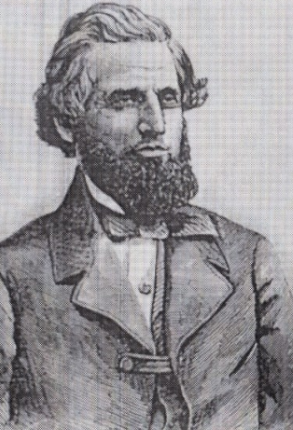
Gest, Erasmus, (1820-1908), surveyor, engineer, railroad magnate, and street railway entrepreneur, wrote a series of papers that have been compiled into an inventory. In them it says “After leaving school in 1836, he took his first position, that of rod man on the Whitewater canal at Harrison, Indiana, on his seventeenth birthday. Nearly all of his long career was spent in some form of transportation: canals, railroads, and street railways. The major exception was a period of over six years, 1841-1847, during which time he was first assistant city surveyor and later surveyor of Cincinnati.
“Gest left a partial record of his work on the Whitewater canal in his reminiscence, How We Lived in the Hoosier State, (volume 1 of the Gest Papers), which he penned in 1883 based on a sketchy diary. He gave accounts of lodging and boarding facilities, primarily in Harrison, Ind., with his expense accounts; social activities in Harrison and along the line of the canal; descriptions of the inhabitants of the country through which the canal passed, and of some of the individuals with whom he worked. Early in 1839 Gest became an assistant engineer on the Cincinnati and Whitewater canal, but suspension of the project soon forced him to seek other employment.
“In November, 1839, carrying letters of recommendation from William Henry Harrison and Darius Lapham, engineer of the Whitewater canal, Gest traveled to Pennsylvania seeking employment. With the assistance of Martin Coryell, a friend made while he had worked on the Whitewater canal and then an engineer on the Pennsylvania canal, Gest was hired as an engineer on the canal at Easton, Pa., working in the capacity until the spring of 1841 when he returned to Cincinnati. Thus ended his five year career as canal engineer.
Biographical resume, Inventory of the Erasmus Gest Papers, 1834-1885, p. 1.
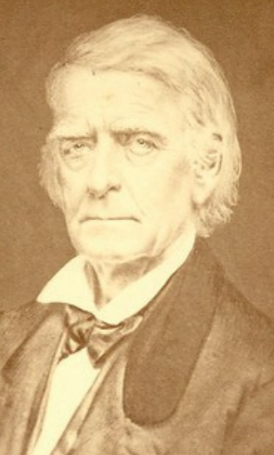
Forrer, Samuel, (1793-1874), at age 16, was lucky to have Mr. Moderitt as his last country school teacher. Moderitt shared his knowledge of plane trigonometry and basic surveying with Samuel. In 1817 Samuel settled at Cincinnati, Ohio, with the intention of applying for a position with the surveyor of public lands, but there were so many applicants that he had to take a job as a journeyman carpenter. While at his employers home he studied mathematics at night and met the county surveyor, who noticed Samuel and inquired about his habits and character. He hired Samuel as deputy surveyor of Hamilton county, Ohio. In 1818 and 1819 Samuel worked as deputy surveyor of the Virginia Military District of Ohio. He followed this with many different surveying jobs of which many were for canals. The chart below shows only his canal related jobs and his promotion up the line.
1820 He examined the summit between Lake Erie and the Ohio River to see if it could be connected by a canal—his first engineering job.
1822-1823 He accepted a position of Junior rodman, then Senior rodman, then Assistant Engineer as surveys began for a proposed canal. Instead two canals were proposed—the Ohio & Erie Canal from the Ohio River at Portsmouth to Lake Erie, and the Miami Canal connecting Cincinnati to Dayton (eventually to Lake Erie and known as the Miami-Eire Canal. Both were put under construction.
1825-1831 Samuel Forrer was the Resident Engineer on the Miami Canal. During this time he located the whole of the Miami and Erie canal and its branches, and a great portion of the Ohio Canal. The Miami Canal opened in Dayton in 1829. The second canal boat to arrive from Cincinnati was called “The Forrer”
1832-33 Samuel was appointed to the Board of Canal Commissioners and served for three years. During that time he served as Acting Commissioner and managed the activities of the Miami Extension canal.
1836 The Board of Canal Commissioners was replaced by the Board of Public Works. Samuel was appointed Principal Engineer of the Miami Canal: to examine and resurvey the Miami Extension canal.
1838 The Board of Public Works disbanded and the Board of Canal Commissioners reinstated. Samuel was appointed to the Canal
Board. It later reverted back to the Board of Public Works and Samuel found work elsewhere.
1845 Samuel returned to the Board of Public Works. Unfortunately he was one of many from the two boards that were investigated for possible financial misdeeds. No fault was found of him. The investigation showed the State owed him $40.92.
1846 He went east to the Chesapeake & Ohio Canal in search of employment. However, the canal company did not have the finances to continue the project.
1850-1853 He worked on a Wabash & Erie Canal contract in Indiana in Gibson, Pike and Daviess counties.
1855 His company—Forrer, Burt, & Company bid for the contract on Section 7 of the Miami-Erie Canal for repairs. They were not the lowest bid so Samual circulated a pamphlet challenging the quality of the work proposed by the lower bids. Unfortunately, the repudiation stood.
1860 Samuel was appointed Resident Engineer of the Northern Division of the Miami & Erie Canal.
1861 Ohio’s Public Works were leased out to private contractors, and he received the contract for the entire Miami & Erie Canal. He was responsible for maintenance and repairs. He remained there until retiring on February 15, 1873.
In the end notes of Canals For a Nation “Samuel Forrer reported his wages as a ‘junior rodman’ on the Miami Canal in Ohio in 1823 at $9 a month, which was raised to $12 when he was promoted to ‘senior rodman’ and to $600 a year when he became an assistant engineer in 1824. Forrer noted that ‘we had few mechanics of any kind in the country at the time.’”
Shaw, Ronald E., Canals For A Nation: The Canal Era in the United States 1790-1860, 1990.
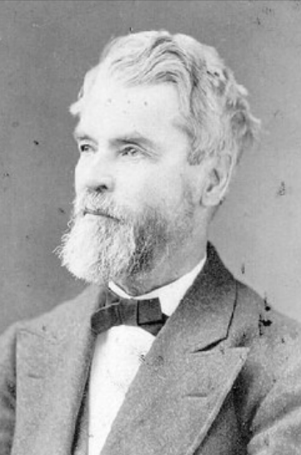
Lapham, Increase Allen, born in 1811, was an American author, scientist, and naturalist. He served on several canal projects, including the canal around the Falls of the Ohio at Louisville. He worked as a surveyor’s rodman on a canal project when he wrote the paper entitled, “Louisville and Shippingsport Canal and the Geology of the Vicinity.” Later, he and his brother Darius cooperated on a paper published in 1832 in the same journal.
Lapham, 1828, p. 65-69
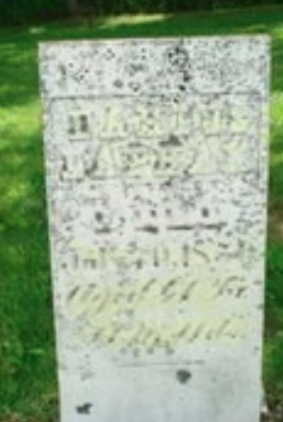
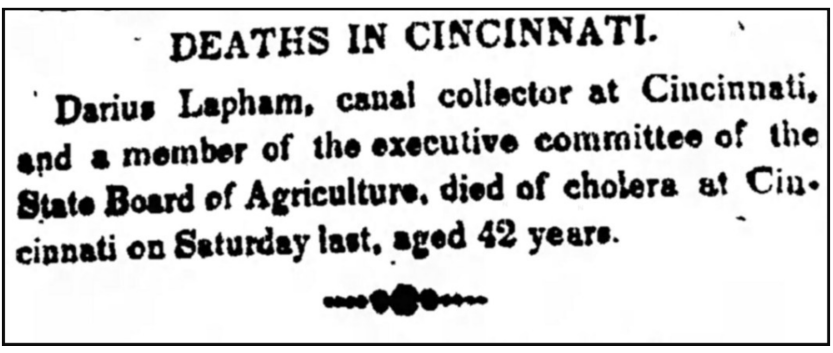
Lapham, Darius, Born in 1809, was the older brother of Increase Allen Lapham. He only lived to be 42 years old, dying in 1850 before photography. Their father was Seneca Lapham, a canal contractor and engineer. Darius’ biggest claim to fame was that he was responsible for the planning of the Cincinnati & Whitewater Canal in 1837. His survey suggested that the commercial traffic from the Whitewater Canal would be 50% greater than the Miami Canal from Dayton. It also stated that either a deep cut or tunnel would be required to pass through the farm of William Henry Harrison at Cleves, Ohio. The decision was made to build a tunnel with bricks made on the Harrison farm to connect the Whitewater Canal at West Harrison, Indiana to downtown Cincinnati, Ohio. It was completed in 1837—six years before the canal officially opened. It was over 1600 feet in length, was 24 feet wide at the water line and the center of the arch was 15 1⁄2 feet above the water. The canal stopped using the tunnel in 1856. It served as a railroad tunnel 1836-1888 when it was abandoned. The Cincinnati & Whitewater Canal reached the Harison dam in November 1843. For canal boats to pass through the tunnel a rope was fastened at each end of it and boatmen pulled on the rope hand over hand while the horses were unhitched and led around the hill.
Find-A- Grave #38838947, Historical marker at Cleves Tunnel’s north portal, Canal Society of Indiana articles in “The Tumble.”
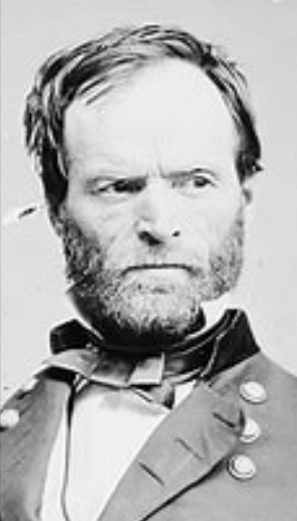
Sherman, William Tecumseh, the Civil War general, received his appointment to West Point within a month after Thomas Ewing, president of the private company building the Lancaster Lateral Canal, wrote a letter to Secretary of War Lewis Cass. At the time “Cump” was living with the Ewings. While there, in 1834, he worked as a rod-man on a surveying party for the “local preacher-turned-civil engineer for fifty cents a day. This was his first paying job, and the teenager enjoyed the money, while learning surveying skills that helped prepare him for West Point engineering classes. During 1835-1836 he devoted most of the his time to studying French and mathematics, two subjects of particular importance at the military academy.”
Marszalek, John F. , Sherman: A Soldier’s Passion For Order, 1993, p. 17.
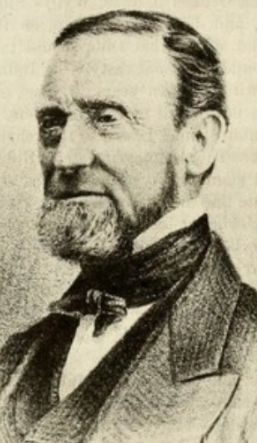
Williams, Jesse Lynch, 1807-1886, Chief Engineer of all of Indiana’s Canals, reports that “In 1824, after the Ohio Legislature had arranged to make the preliminary surveys of the Miami and Erie Canal, my brother secured me a place as rodman at $9 per month. At this I worked all that season, assisting Thomas J Matthews to run the first level between Cincinnati and Dayton. A few months later, when the survey was extended to Maumee Bay, Mr. Matthews carried the compass. For a long time we were struggling through a most dense wilderness, not finding a house or any trace of civilization for upward of fifty miles… Whenever it rained so that we had to remain in our tent, they would keep me to work solving some problem, laying down the principals so clearly and concisely that I can never forget them.” So Jesse, who began as rodman, worked his way up to Chief Engineer through on-the-job training.
“Early Recollections of the Hon. J. L. Williams of Fort Wayne,” Fort Wayne Daily Sentinel, June 8, 1874.
Erie Barge Canal In a November 3, 1903, referendum, a majority of New Yorkers authorized an expansion of the (Erie) canal at a cost of $101,000,000. In 1905, construction of the New York State Barge Canal began, which was completed in 1918 at a cost pf $96.7 million.
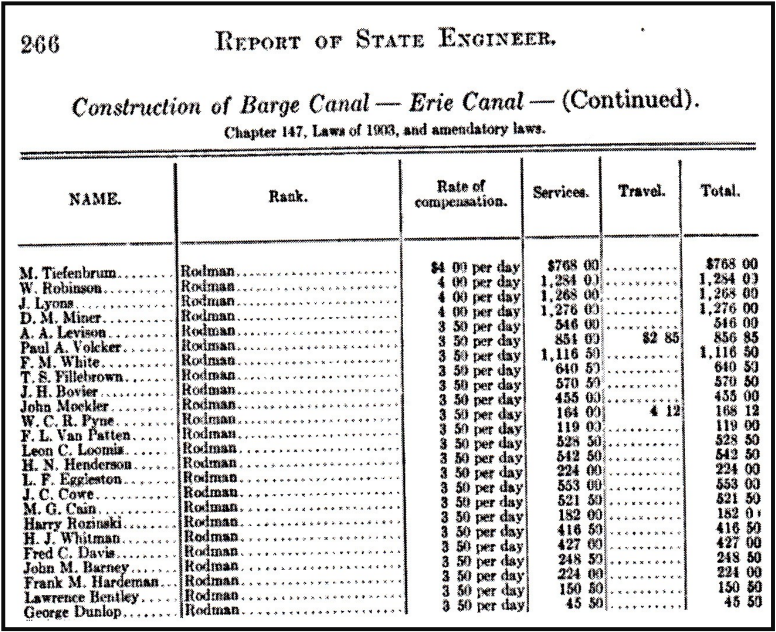
Annual Report of the Engineer and Surveyor of the Erie Barge Canal, 1903 p.266.
News from
Delphi, Indiana

News and Photos courtesy “Currents,” news from the Carroll County Wabash & Erie Canal Association
Canal Park Clean Up
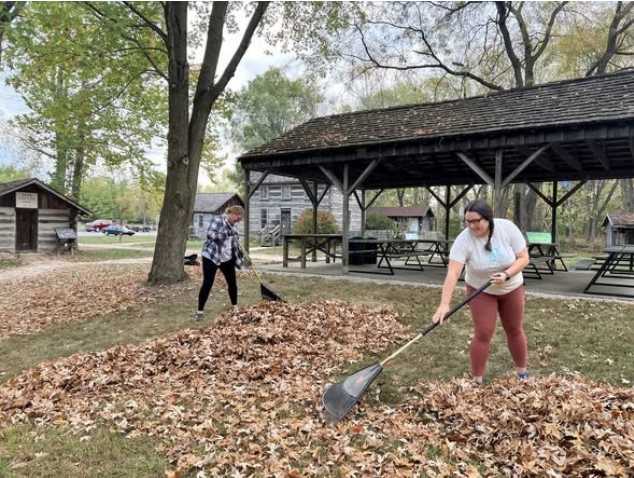
The Lilly Scholars Network and Delphi FFA spent a lovely fall morning cleaning up Canal Park and getting it ready for winter. They were treated to a tasty lunch by Beta Psi Delphi Chapter Psi Iota Xi.
1830 Log Cabin Donated
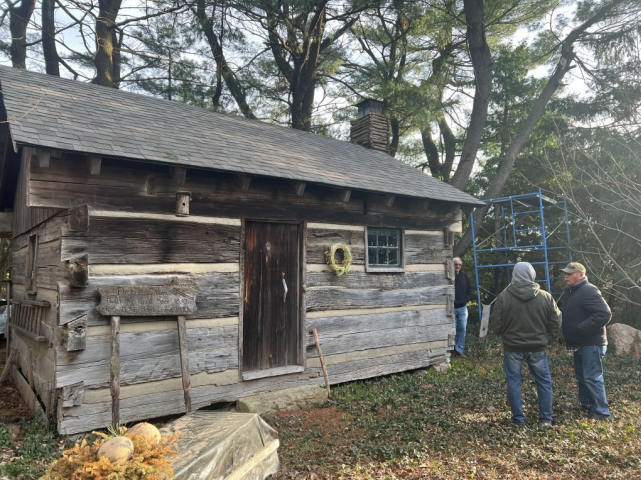
Warren County residents Bill and Patti-Joy Crone have donated an 1830 log cabin originally owned by Urial Deer to the Wabash & Erie Canal Park. The cabin will be both the newest and oldest addition to the park’s Pioneer Village. The cabin was restored in 1970 by Bill’s father. It will be used for demonstrating historic trades with guest artisans and also for paper-making. Moving the cabin was made possible by a grant from North Central Health Services administered by the Arts Federation and financial support from Peter and Linda Cooper. The Carrol County W & E Association hopes you visit the park in 2026 and step inside this new acquisition.
McCain Receives Limelight Award
Dan McCain was presented the Limelight Award by the president of the Delphi Preservation Society, Christina Langsdorf, and the president of the Delphi Opera House, Anita Werling on October 29, 2025 for a lifetime of service and dedication to Carroll County and its history. After a meet-and-greet in the Opera House lobby, attendees were provided with a meal from Custom Select Catering and dessert from Stone House Bakery.
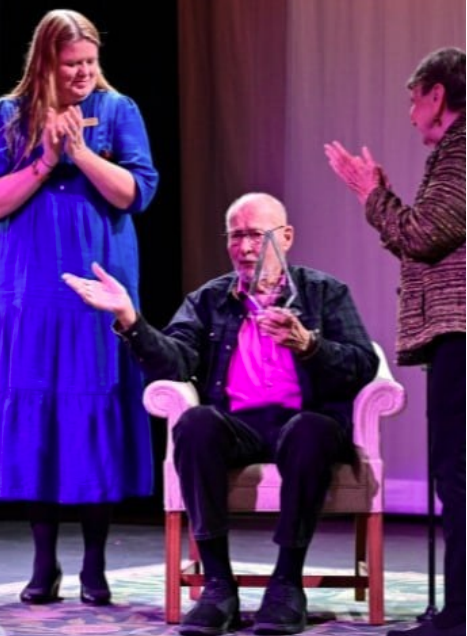
The evening’s program was presented from the Opera House stage. Mike Tetrault, Canal Park’s executive director, interviewed Dan about how the canal was restored, developed over the past 50 years and had become a unique historic site through the efforts of volunteers such as George Obear, Jim French, Roseland McCain (his mother) and countless others.
What a memorable tribute to Dan an incredible canawler. The audience gave Dan a spontaneous Hip-Hip-Hooray!
The Canal Society of Indiana has been proud to work with Dan, a charter member of CSI, over the years. We praise all his accomplishments at Canal Park and hope he looks back on them with fond memories.
Widewater in Lafayette
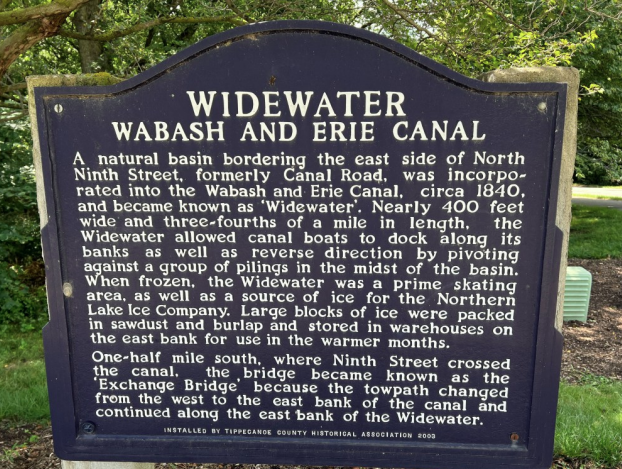
As short mention and picture of a marker installed by the Tippecanoe County Historical Association in 2003 in Lafayette, Indiana was included in an article about ice in “Currents.” It also has good information about the Widewater, how canal boats turned around, and the location of the “Exchange Bridge” south of it.
Canal Park Announces 2026 Schedule
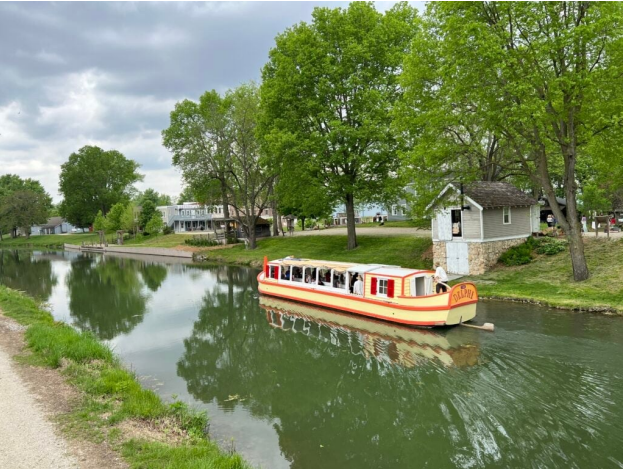
Canal Boat Rides, Pioneer Village, Canal Interpretive
Center, Reed Case House and much, much more!
| Date | Event | Time |
| April 11 | Spring Cleanup Day | 9:00a – 12:00p |
| April-May | Spring Session Historic Classes | |
| May 23 | Canal Season Opening Day 104 pm [continues ever Saturday noon through Sept. 12] | 10:00a – 4:00p |
| June 6 | Pioneer Village Day | |
| July 4 | Canal Days Festival | 10:00a – 4:00p |
| Aug. 15 | Family Day | |
| Aug.-Sept. | Fall Session Historic Classes | |
| Sept. 12 | Canal Season Closing Day | |
| Oct. 17 | Fall Cleanup Day | 9:00a – 12:00p |
| Oct. 20 | Wabash & Erie Canal Park Annual Meeting | 7:00p |
| Nov. 7 | Hike the Trails Day, | dawn to dusk |
| Dec. 5 | Christmas at the Canal Festival | 10:00a – 4:00p |
| Dec. 26 | Day After Christmas Guided Walk | 1:00p |
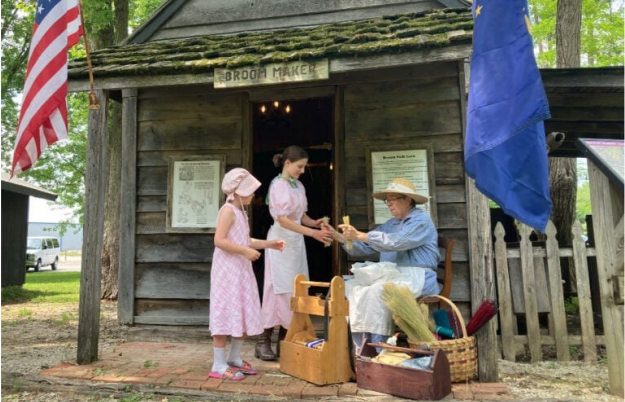
Every Saturday afternoon during Canal Season, join us 1-4PM at Wabash & Erie Canal Park for family fun and an engaging Indiana history experience! Entry to the park is free, and there are no parking fees. Be sure to grab yourself a Combo Ticket to enjoy all ticketed attractions and save a few dollars: for guests ages 13+, it’s $20 for the canal boat ride, museum, and Reed Case House. For guests ages 12-under, the Combo Ticket is just $7.
News from the
Canal Society of Indiana
Outreach Events & Programs
Larnin’ 1840s Style at Forks of the Wabash History Park
Margaret Griffin – Photos and text
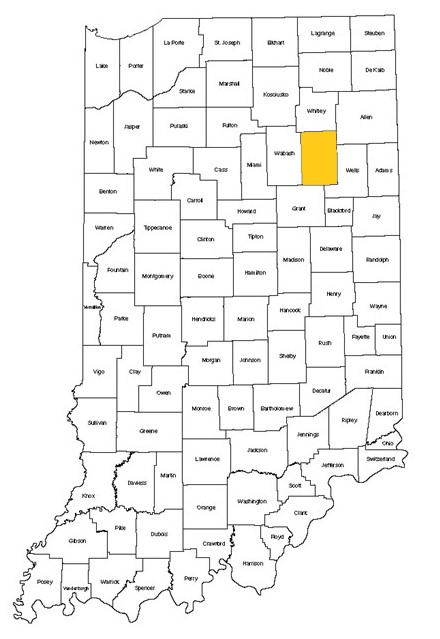
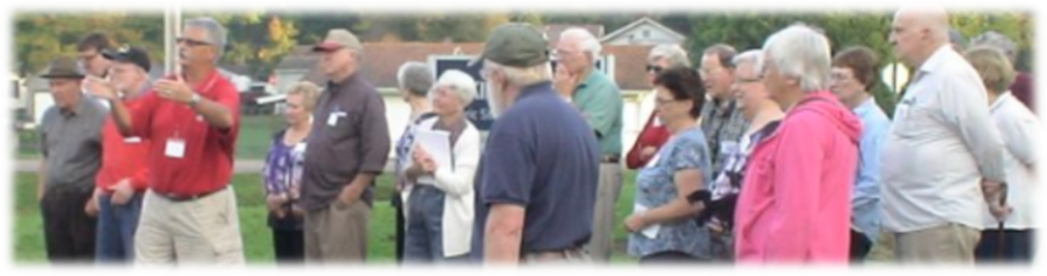
Growing numbers of elementary students are participating in Spring and Fall tours at Forks of the Wabash History Park in Huntington. For 2025, the totals came to 3,471 children, 197 teachers and 832 parents. These excursions take place four days a week during April, May, September and October.
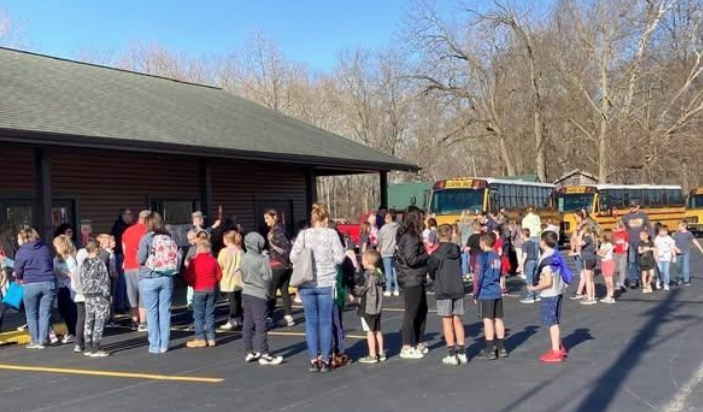
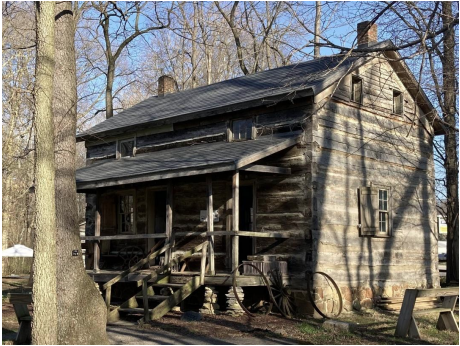
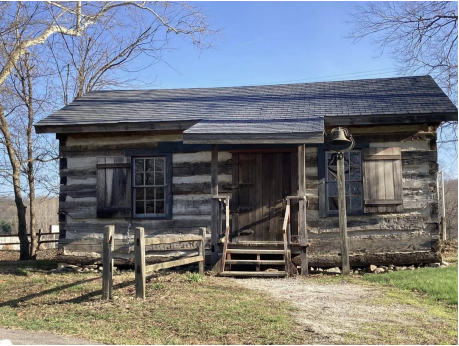
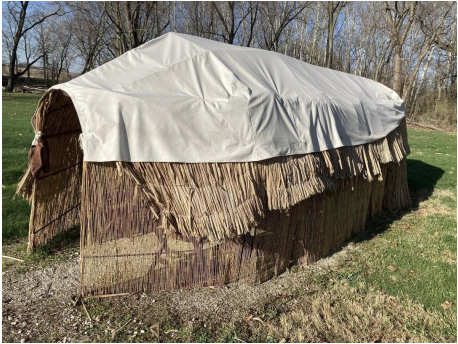
Volunteers guide small groups through stations. The permanent sites include Chief Jean Baptiste Richardville’s Treaty House, the Nuck Family Log Home, Schoolhouse, and a Miami Wigwam. These are all period buildings that have been moved to the park’s acreage just off of US 24. In the modern Museum Center, a special room houses murals, maps and boat models of the Wabash and Erie Canal.
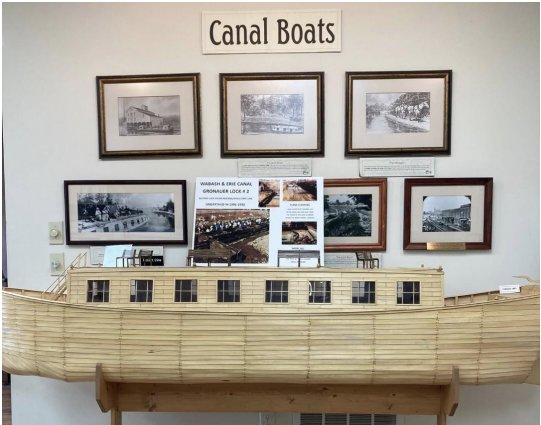
Huntington. Notice the poster of the historic
finding of the Gronauer Lock near New Haven in
the 1990s.
Visitors may also see rotating exhibits: Early American Music, Pottery, Musket Shooting or an Archaeological Dig where they find antique buttons and arrowheads. Interpreters in costume give between six and eight presentations lasting 18 minutes apiece. A typical tour begins at 9:30 a.m. and ends a little after noon –sack lunch time under the pavilion!
In the Canal Room, the story starts with President George Washington, who envisioned a network of canals to transport people and goods across the new nation. Many were built in the first half of the Nineteenth Century, including the Wabash and Erie Canal which connected the Great Lakes with the Ohio River. The first part of the canal was built by Irish workers between Fort Wayne and Huntington, with a port just outside of the room the children are sitting in.
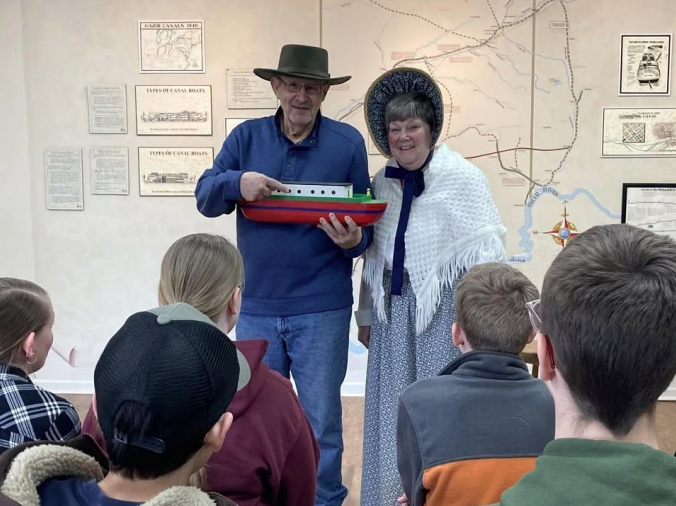
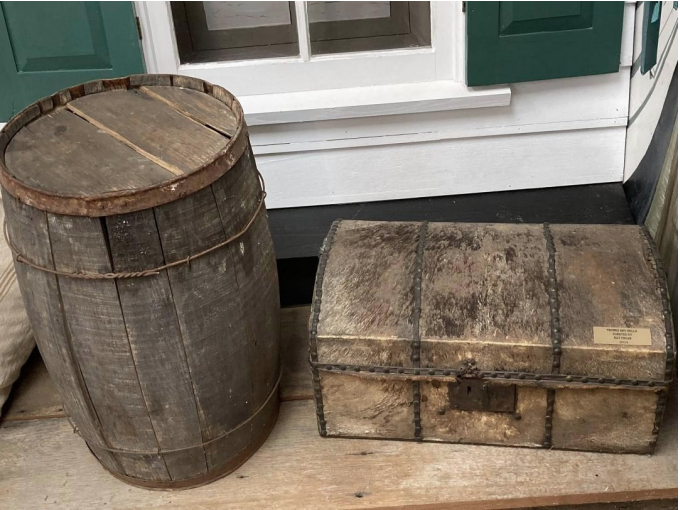
Visitors are surprised to learn that the Wabash & Erie was the longest canal ever built in America at 468 miles (though the final distance didn’t last for long), and that great loads could be pulled by the horses or mules on the towpath.
One little boy, not understanding the towpath part, exclaimed, “I didn’t know horses could swim that fast!” Another asked the interpreter, “Why are you dressed up like Little Bo Peep?” The modern context of some words was revealed when a group was told that barrels of nails would be carried by the boats. “NAILS?” They were thinking of ads on TV — artificial press-on fingernails.
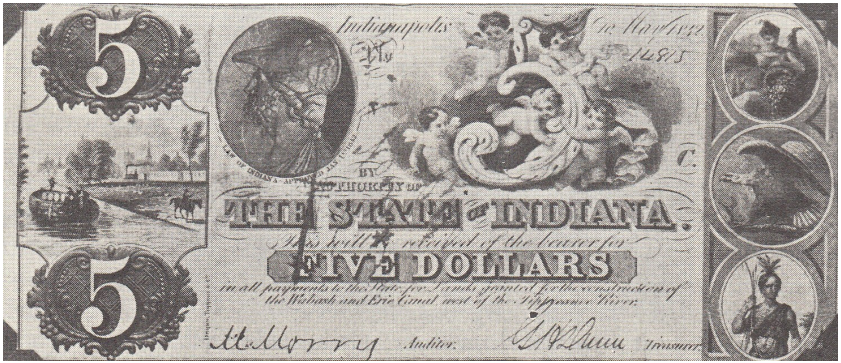
Popular this year has been passing out examples of “blue dog” five-dollar bills. CSI provided copies on blue paper like the ones canal workers earned, and could be used to pay taxes or buy farmland from the government. Informed about the high costs of the canal, children are told that the canal company printing its own money was one way to try and solve the problem. Of course, there are more comments: “Can I use this on eBay?”
Students come from public and private schools in surrounding counties. Most are fourth graders, but information may be adjusted for first, second and third graders. The Forks of the Wabash History Park also schedules visits for home schoolers. Private tours are sometimes arranged in the afternoons.
Master gardeners, lawn care workers, and gift shop workers are all volunteers. During Spring and Fall the native Indiana plants and flowers on the grounds give a spectacular view. This is a popular family place for walking and jogging, and there is an annual “Splash” event on the river in the summer.
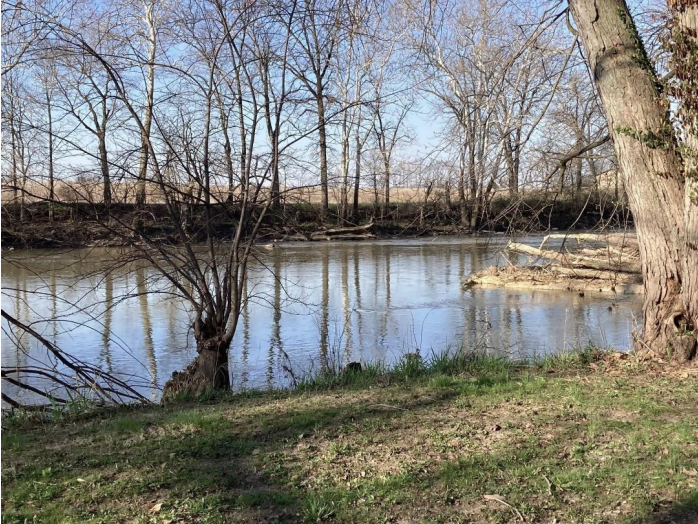
windows and extends down along the park to where the river
forks around an island.
Many projects, such as the recent restoration of the Richardville Home, are funded all or in part by grants. The proceeds of the Pioneer Festival in Huntington in late September also go to the Forks.
A trading post is in the works for next year, as is a “Walk to the Lock” along the towpath to a deep gully which once was Lock No. 10 (one of 73 on the Wabash & Erie). It will be an opportune time to explain how boats were raised and lowered with the changing lay of the land, and also of the tragic departure of the Miami people by canal boats in 1846.
You can read more about the Forks of the Wabash History Park on their website, www.forksofthewabash.org. For tour requests call (260) 356-1903.
On April 25, 2026, CSI will hold its Spring a seminar at this location. Mark your calendars!
Pioneer Days 2025
Jo Ligget

The Mini Pioneer Days program for fourth graders in Vigo County was held September 23 through September 26 in the Pioneer Village at Fowler Park in Terre Haute, Indiana. Nine different stations were presented with topics from blacksmithing to children’s games in the 1800s.
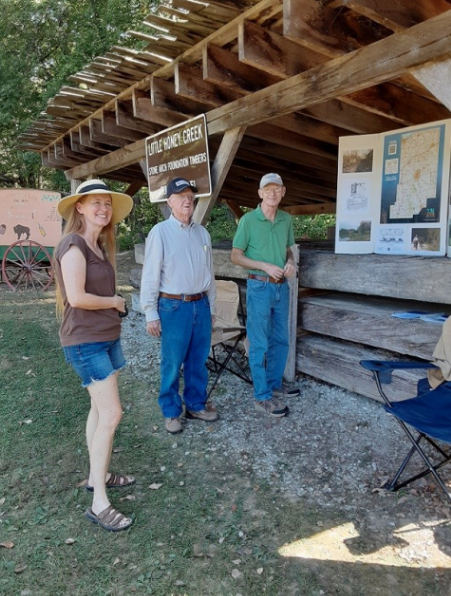
Sam & Jo Ligget were stationed by the Irishman’s Covered Bridge and the preserved timbers from Culvert 151. The children were told that the bridge was built over Honey Creek on Eldrige Road in 1845. They were to imagine standing in that bridge shortly after and watching men with picks and shovels dig a “big Ditch”—the Wabash & Erie Canal—just a few yards north. Next came the railroad at the same location, and now the Terre Haute to Riley Trail is being built there.
Culvert 151 and its massive timbers were explained as well as reasons why the canal was built and why it ceased to operate. The route through Vigo County was traced on maps with places pointed out that students might recognize. Forty-three packets of Blue Dog scrip were handed out to teachers for use in their classroom canal lessons along with contact information for the Canal Society of Indiana.
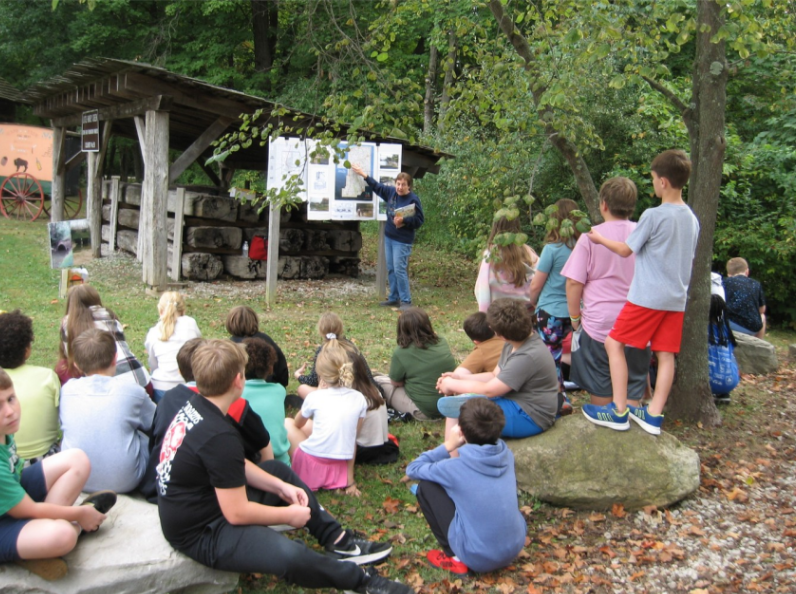
In previous years, 6 groups toured each day with 15 minutes at each station. This year, 9 groups toured each day. On the first day, there was a 2-hour delay because of fog and each station was reduced to 9 minutes! There were 13 minute slots the remaining days. In the 4 days approximately 1,000 people visited the station including students, teachers, and chaperones.
On October 4 and 5, Sam and Jo were at the same station for the regular annual Pioneer Days. During this 2-day event, 123 people stopped by the Culvert 151 display, and 50 handouts as well as a number of Canal Society QR cards were given out. The handouts featured the map of Indiana canals on one side and an explanation of lock operation with an invitation to visit the new Lock 47 Park at Riley, Indiana, on the other side.
Ligget Speaks to Rotarians
Jo Ligget
On September 30, 2025, Sam Ligget presented a program about the Wabash & Erie Canal in Vigo County, Indiana, to a meeting of Rotary International at the Vigo County History Center. About 20 Rotarians were in attendance as well as 4 high school students from the Terre Haute North Vigo Interact Chapter. There were several good questions and comments afterwards.

CSI Members Awarded For Volunteering
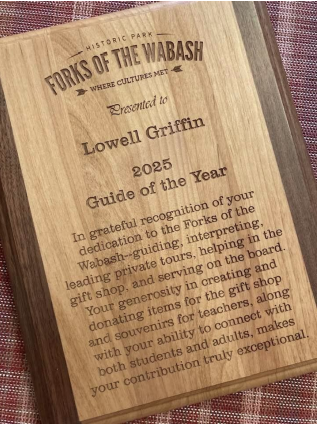
Lowell Griffin On November 5, 2025 at the Forks of the Wabash’s annual dinner, Lowell was named “Guide of the Year.” He received a plaque “in recognition for your dedication to the Forks of the Wabash — guiding, interpreting, leading private tours, helping in the gift shop and serving on the board. Your generosity in creating and donating items for the gift shop and souvenirs for teachers, along with your ability to connect with both students and adults makes your contribution truly exceptional.
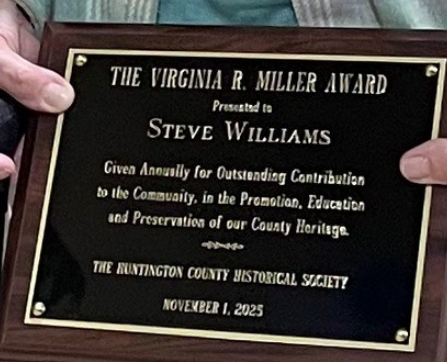
Steve Williams On November 6, 2026, at the Huntington County History and Education Center, Steve was honored by receiving the Virginia R. Miller Award, which is “Given Annually for Outstanding Contribution to the Community in the Premotion, Education and Preservation of our County Heritage”. As Steve was unable to attend the event, his wife Sharon accepted the plaque.
Signage Program
Dearborn County CSI Signs Now Up

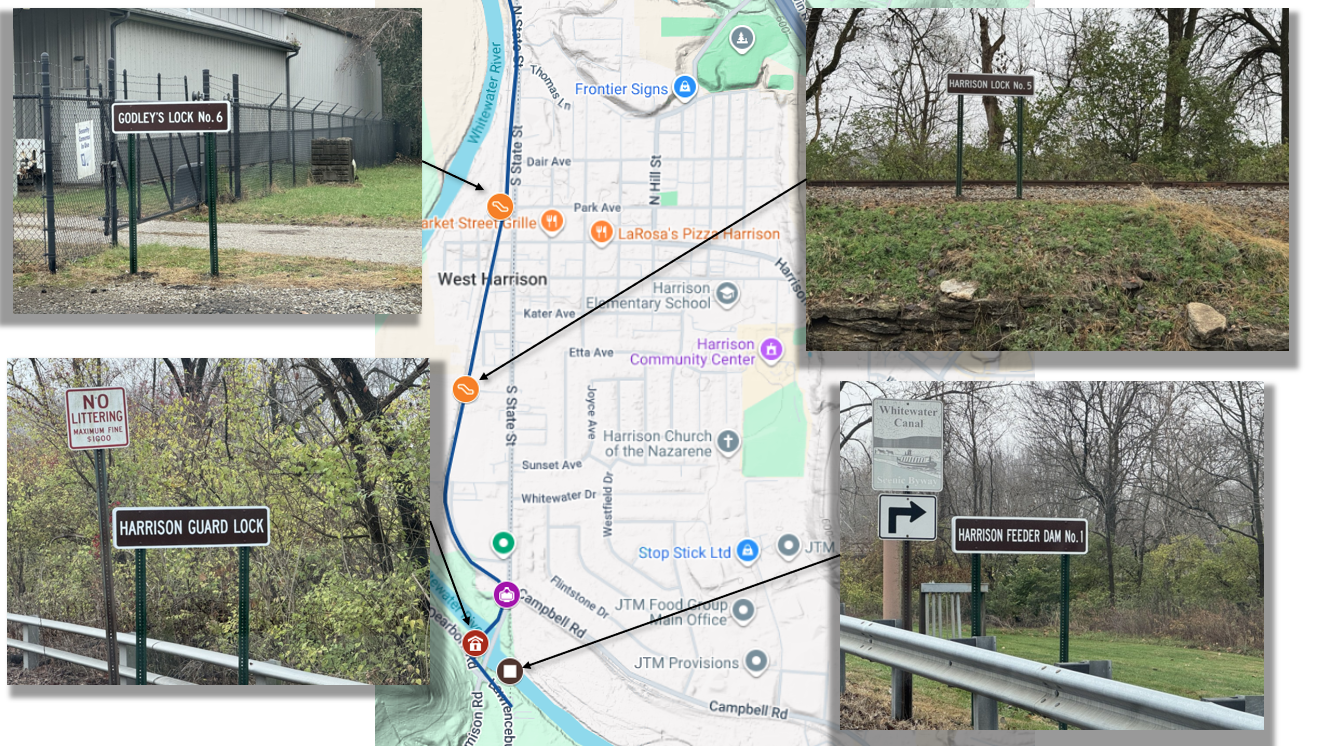
The CSI signs for Godley’s Lock No. 6, Harrison Guard Lock, Harrison Feeder Dam No.1 and Harrison Lock No. 5 have been erected in Dearborn County. Marshall McAdams, who is with the town of West Harrison, has sent the following photos taken by Jason Hoffman. A community celebration and sign dedication is being planned by Ron Morris on a weeknight in March. More information later. We hope to see you there.
Whitewater Canal

CSI president, Ron Morris of Centerville, Indiana, reports he is working with Whitewater Valley officials to expand the CSI signage program in the valley.
Dearborn county is working on the final placement and erection of the signs for the Whitewater Canal in their area and hopes to have a dedication ceremony in the future.
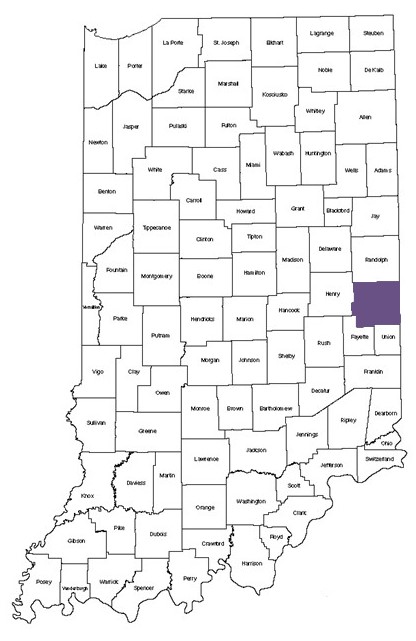
In Wayne county he is recommending to Wayne county officials locations along the Hagerstown Canal to Cambridge City where CSI might be placed.
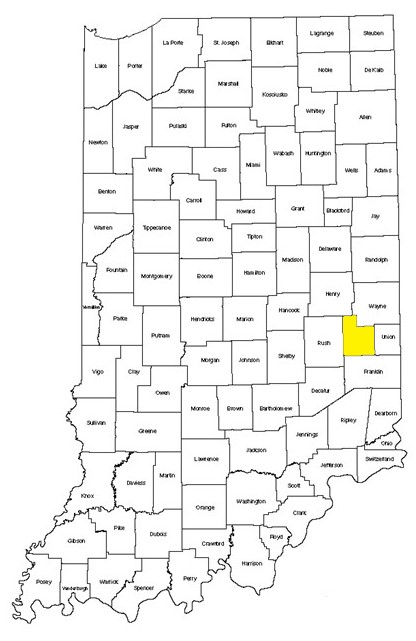
Connersville is working to expand their trail system along the Whitewater Canal. Here Ron is working on texts, maps and pictures for panels to be placed along this trail when it is completed.
Wabash & Erie Canal

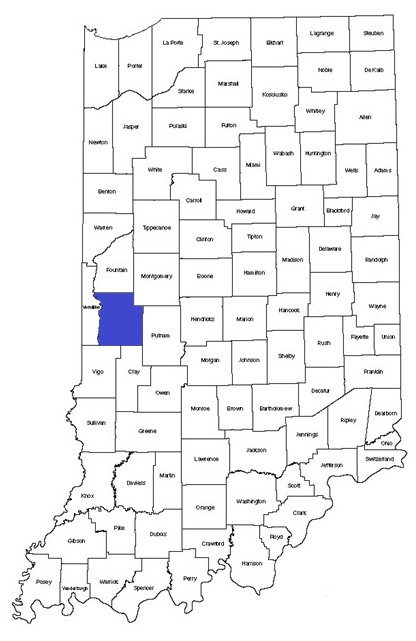
CSI member, Troy Jones, reports that he and a nearby farmer dug and poured footings for the CSI sign along the Wabash & Erie Canal in Parke County, Indiana this fall. Later the sign was erected, but almost immediately an official stopped by and told the farmer that he had to take it down because Tow Path Road was going to be paved from there to around where the road to Howard cuts off. Then after that is completed the canal through there is going to be dredged up to Lodi. The official had no timeline on when these projects would be completed. The farmer removed the sign the following day. It will be stored until these projects are finished.
Troy had better news about the CSI signs he placed at the bridge into Lodi and at Raccoon Creek near Armiesburg. Someone in and around Lodi has taken an interest in the sign, kept the weeds cut back and has dug a flower bed around it in which colorful artificial flowers were planted. People coming into Lodi from the south will be greeted by the sign. He also notes that the owner of the nearby property in Armiesburg keeps the weeds cut beneath the sign at the creek and is keenly interested in having the weeds and vines at the abutments of the aqueduct south of Armiesburg removed by someone.
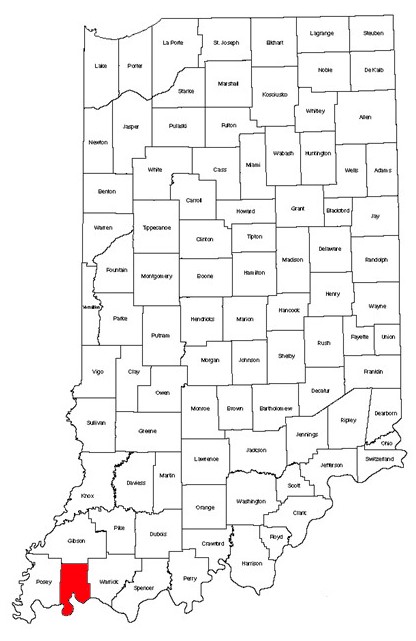
Bob Schmidt, CSI Treasurer, is working with Tim Miller, Historic Preservation Officer for the city of Evansville, Vanderburg county, Indiana, to locate and place a series of CSI signs along the route of the Wabash & Erie Canal from Green River Road to the canal basin at Pigeon Creek. The owner of the old 1850s Canal House on Indiana Avenue, the last canal era remaining building. has decided he will place a different type of sign in his yard to mark this historic house.
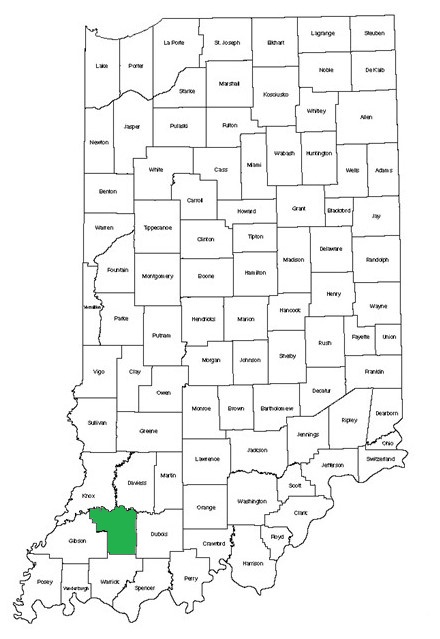
Preston Richardt, CSI Web-master, is working with locale property owners to mark some of the still watered areas of the Wabash & Erie Canal off State Road 57 south of Petersburg in Pike County. One of these is where the old town of Hosmer was located.

Tom Castaldi, CSI Director, is working to get the early Eel River Aqueduct sign in Logansport, Indiana, put back into the ground and have a new CSI sign placed where it is more visible either on the side of a building or in the nearby city park across from the police station.

“Tom” Frey

1942-2025
Find-A-Grave
277954503
Thomas Wayne “Tom” Frey was born on March 6, 1942 to the late Charles Franklin Frey and Virginia Clair (Faust) Frey in Covington, Fountain County, Indiana.
Tom graduated from Covington High School, class of 1960 and attended Indiana State University, before joining the United States Navy, where he served for four years including the Gulf of Tonkin. In November 1966, he married his wife, Sandra (Starkey) Frey.
Tom worked in sales/management at Monninger Concrete Block in Terre Haute, Indiana and Steel Grip Safety Apparel in Danville, Illinois until his retirement in 2008. In his free time, he volunteered at the Terre Haute Children’s Museum and helped with the backpack program for elementary children through the Clinton First United Methodist Church.
On January 2, 2025 Tom died peacefully in Terre Haute, Vigo County, Indiana at the age of
Visitation was held at Covington United Methodist Church on Tuesday, January 7, 2025 from 1-3p.m. Burial was in Mt. Hope Cemetery in Covington, Fountain County, Indiana.
Tom is survived by his wife, Sandra; his children, Michael Frey (Mellissa), and Kelly Frey Siddiqui (Peter); three sisters, Judy Caviglia (Mario), Suzy Allen (Denny) and Kathy Fields (Mark); and three granddaughters. He was preceded in death by his parents and his brothers Richard Frey and Jerry Frey.
In 2023 Tom joined the Canal Society of Indiana and was a member at the time of his death. He also was a member of VFW Post #2395, Covington United Methodist Church, Clinton Lions Club and Clinton First United Methodist Church. He was elected and served on the Troy Township Advisory Board. As a 32nd degree Mason he was with the Valley of Terre Haute Scottish Rite and Fountain Lodge #6 F&AM.
Suggested memorials are to Covington United Methodist Church, Covinton Community Foundation or the VFW Post #2395.
Stephen “Steve” J. Williams
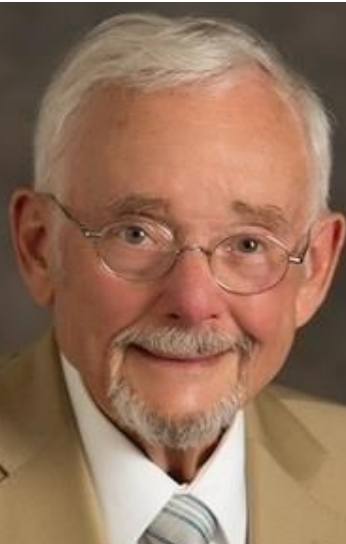
1940—2025
Stephen “Steve” J. Williams, 85, of Roanoke, Indiana, passed away on December 5, 2025. He was generous with his talents, time and service serving for more than thirty years as trustee of Ashland University; a long-time elder of the Roanoke Brethren Church; a Freemason for 55 years in the Roanoke Lodge; a member of the Scottish Rite receiving his 33rd degree; and serving at various times on numerous boards and organizations in the Roanoke area, including most recently the Roanoke Area Heritage Center and the Canal Society of Indiana. He received the Virginia R. Miller Award for his contributions to the promotion of historical preservation and education in Huntington County given by the Huntington County History and Education Center this year.
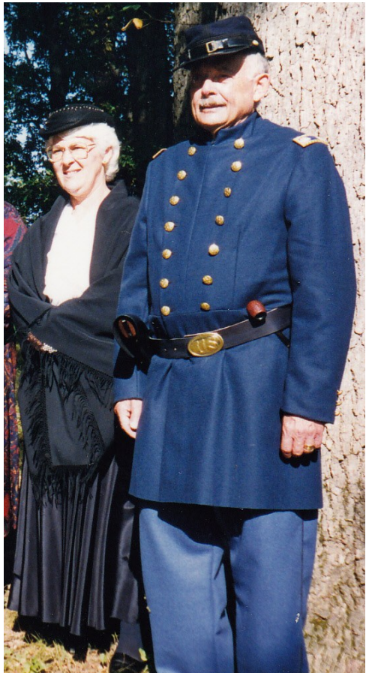
Steve had a one-of-a-kind personality. According to his family, he was generous, stubborn, full of joy, had a warped sense of humor and a strong work ethic. He read voraciously especially historical works about the Civil War and Abraham Lincoln. He had a treasure trove of jokes and stories about one of his professional mentors, Willard Shambaugh. He was a really accomplished woodworker and, as a kid who grew up in his father’s hardware store, had every kind of odd screw or nut. He would let no one out-work him. A graduate of Indiana University, he was a die-hard fan of the football program prior even to the Lee Corso era and still enjoyed watching a game. He installed a zipline for his grandchildren’s enjoyment putting his other party guests in extreme danger. He also threw a summer birthday bash for his grandchildren every summer for twenty-plus years. Probably, party game and bounce house vendors will miss him dearly.
Steve was definitely a family man. In addition to Sharon, his wife, he is survived by his sister, Jill Law; daughters, Jennifer (Randy) Pickard of Roanoke, and Rebecca (Mike) Zakowski of South Bend; sons, Nathan (Amanda) Williams of Roanoke, and Benjamin (Carrie) Williams of Fort Wayne; and 10 grandchildren: Jack Pickard, Hannah Williams, Reid Pickard, Bethany Williams, Allison Williams, Samuel Williams, Zachary Zakowski, Katie Williams, Becca (Grandon) Helmick and Connor Zakowski.
Calling hours at Roanoke First Brethren Church, 415 Main Street, Roanoke, Indiana, were on Sunday, December14, from 2:00 p.m. to 6:00 p.m., and Monday, December 15, from 10:0 a.m. to noon, with the funeral following. He had a private burial.
Preferred memorials were to Pathfinder Services, Community Harvest Food Bank, or Roanoke First Brethren Church. Arrangements by McElhaney Funeral Home Roanoke Chapel, 240 Crestwood Dr., Roanoke, Indiana. Steve’s obituary was published by Fort Wayne Newspapers December 9, 2025.
Steve and Sharon joined the Canal Society of Indiana in 2005. Steve was elected to the CSI Board of Directors in 2017 and was a Director at the time of his death. We appreciate all his help and contributions over the years. He will be missed.
2025 CSI Board Meeting and Annual Report
November 15, 2025
Hosts: Jo & Sam Ligget and Suzy Dunning

Grand Opening Celebration of
the CSI sponsored exhibit
“Unlocked Legacy” at the Vigo
County History Center created
by Suzy Dunning, Curator.
Vigo County Historical Museum
929 Wabash Avenue, Terre Haute, Indiana
Caterer: McAllister’s Deli
Upon arrival everyone was given a history book donated by Gerald Getty or Brian Migliore before picking up a bag which contained their name tag, board booklet, other information for the meeting, and also a note pad and pen, and information about Terre Haute that was added by Jo Ligget. Ron Morris, President, called the meeting to order and we had a moment of silence for members who had departed this past year. Everyone was asked to read Ron’s annual message, give the secretary any corrections, additions or deletions they had to the minutes of the last board meeting that had been sent to them earlier, and asked for a report from the treasurer. He then started going through the agenda and covered CSI’s old business from the last meeting. The box lunches had arrived and we broke for lunch. During lunch names were drawn for the large frog centerpieces donated from Carolyn Schmidt’s frog collection. The frog is CSI’s mascot. Following lunch Ron called the meeting back to order and the business for 2026 was discussed with many good ideas put forth. The meeting was then turned over to Suzy Dunning and her researcher Grant Goddard who talked about the “Unlocked Legacy” exhibit they had created for CSI. Everyone then went to the second floor to view this outstanding new exhibit. They had about an hour to read the history of th Wabash & Erie Canal in Vigo County, view the canal video, try out the hands-on exhibits, and take pictures before returning to the meeting room where they were treated to sparkling apple juice, miniature pumpkin pies, cupcakes, etc. furnished by the museum.
Directors in Attendance: 11
Suzy Dunning
Margaret Griffin
Margaret Griffin
Jeff Koehler
David Kurvach
Jo Ligget
Sam Ligget
Ron Morris
Mike Morthorst
Bob Schmidt
Carolyn Schmidt
Mike Tetrault
Directors Absent: 7
Tom Castaldi
Jerett Godeke
John Hillman
Preston Richardt
Sue Simerman
Steve Williams
Candy Yurcak
Guests: 7
Marla Flowers
Grant Goddard
Lowell Griffin
2024-2025—President’s Review
The good news is that the Canal Society of Indiana is active and engaged across the state in guarding, exploring, and interpreting our canal heritage.
This past year we reorganized the Executive Committee of CSI to pursue a higher level of state and national recognition of all our historic canals. Our Board of Directors reorganized to reflect all regions of our canal related activities. We continued to provide activities for our membership in addition to more community outreach through signage and website development.
We continued to place our CSI signs in strategic spots along canal routes. New locations this year were in Dearborn and Parke counties and in the communities of Elnora and Williamsport. We continued to request our members identify additional locations where property owners could place the CSI furnished signs.
Our education program for school children this year remained vigorous. CSI members Sam and Jo Ligget and Lowell and Margaret Griffin provided programs in Terre Haute and Huntington. To have some tangible take home material CSI printed copies of Blue Dog canal scrip that was used during canal times. These were very popular programs with young audiences.
Our adult education programs continued this year with special presentations by board members Sam Ligget, Preston Richardt and Jeff Koehler. We supported the dedication of Lock 47 at Riley with CSI members providing information about the Canal Society and the Wabash and Erie Canal. Marla Flowers and Suzy Dunning from the Terre Haute Historical Museum were also there representing our new CSI headquarters location at the junction of the Wabash and Erie Canal and the National Road. Moreover, the Vigo County Historical Museum has committed to a new exhibit on the Wabash and Erie Canal. The exhibition will open soon for visitors.
We conducted symposiums at the Terre Haute Museum in the Spring but had to cancel the one at the Learning Center in Williamsport this Fall. Terre Haute’s was well attended, bringing in our members and local residents to learn more about Indiana canals. Moreover, the high-quality presentations at these symposiums make these events distinctive.
In October, Ron Morris and Bob Schmidt made a presentation at the Indiana Historic Preservation Conference held in Fort Wayne. This was a great opportunity to reach a wider audience at the state level for our group. Furthermore, it provided visibility for canals with preservationists who may not understand the importance of the internal improvements during the pioneer period.
Ron Morris had two of his earlier articles from The Tumble reprinted in the Chesapeake and Ohio Canal Association’s publication in September 2025 and December 2025. Information about the Canal Society of Indiana was included with his reprinted articles. Future articles in this series will describe the C & O Canal from Harper’s Ferry to Washington, D.C.
In June, the Canal Society of Indiana learned of the State Museum’s plan to close the Whitewater Canal Historic Site. This announcement was quickly followed by the news that a Lilly Endowment grant had been received, and the site remained in operation. All this activity generated national attention by the American Canal Society. They gave the Whitewater crisis wide coverage in the September issue of their publication, American Canals. Currently the Canal Society of Indiana is participating with local Whitewater groups to determine the next steps for the evolving changes at the site. This year the Canal Society of Indiana is planning a fund-raising effort to provide for future needs at the site including signage, literature, and interpretation.
Carolyn Schmidt and Preston Richardt continue to provide our membership with timely information through The Tumble and our CSI website at indcanal.org. It is extremely important that our members continue to provide reports and information to them so that our members are kept up to date on all canal issues.
Thank you for allowing us to be a part of your life this year. We look forward to more canal adventures in the next year.
Dr. Ron Morris